Africa Climate Collaborative Project at the University of Ghana and CEDSA Co-Hosts Seminar on Inclusive Education for Climate Resilience
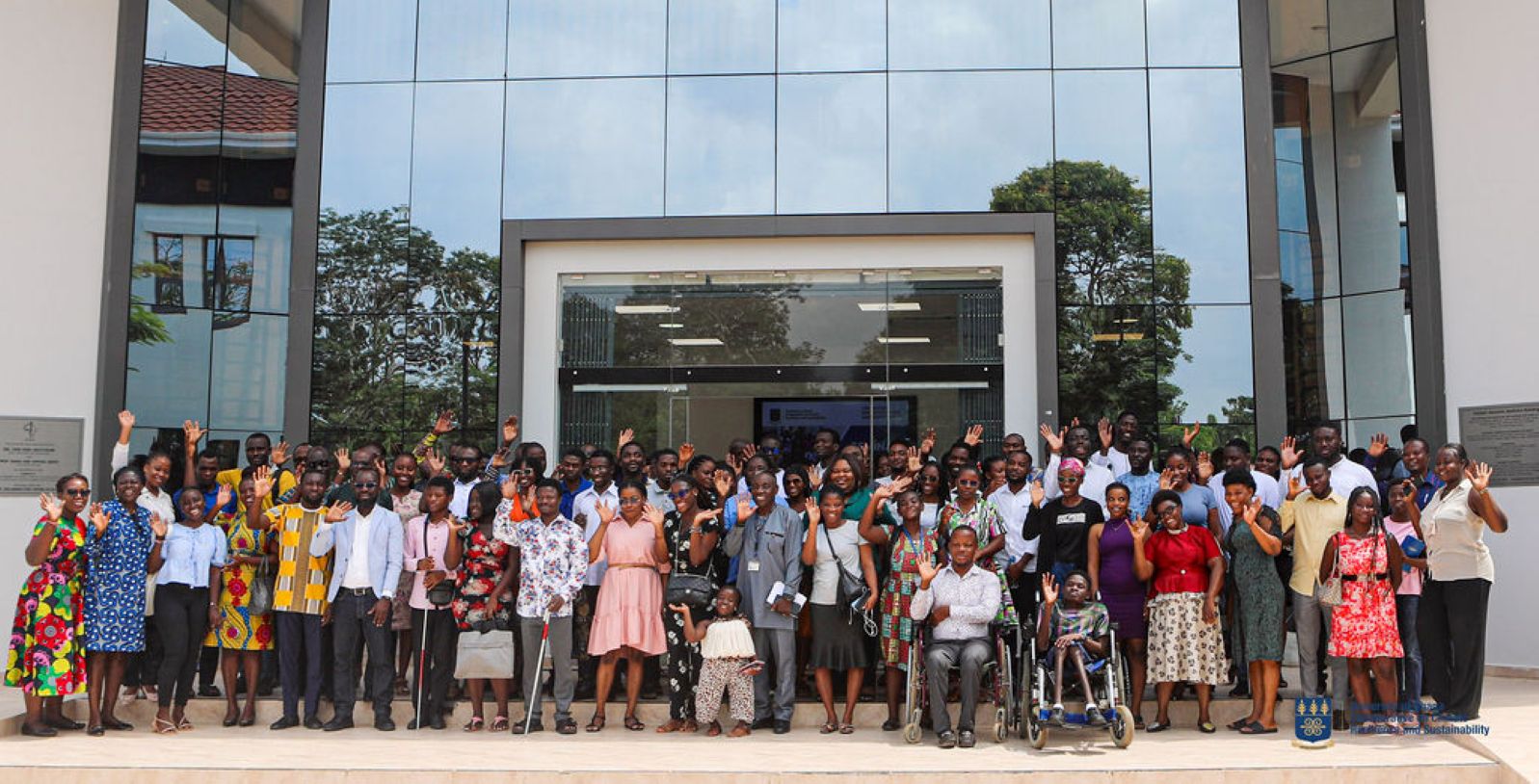
The Africa Climate Collaborative Project at the University of Ghana, in partnership with the Centre for Disability Studies and Advocacy (CEDSA), recently hosted a seminar exploring the intersection of inclusive education, climate resilience, and sustainable development. Held at the West Africa Genetic Medicine Centre (WAGMC) Auditorium, the event brought together educators, psychologists, climate experts, students, and Persons with Disabilities to exchange ideas and solutions.
The seminar, Fostering Climate Resilience and Sustainable Development Through Inclusive Education Practices, highlighted the importance of accessible education systems as a foundation for building societies that can withstand environmental challenges. Professor Gerald Yiran, a respected geodetic engineer and geographer, chaired the event. He opened the day’s proceedings with a note of urgency: “This topic is not only important but urgent, due to the extreme climate conditions we are experiencing.” He encouraged participants to be fully engaged in the discussions.
Facilitated by Dr Peter Ndaa, Acting Director of CEDSA and Head of the Department of Occupational Therapy at the University of Ghana’s School of Biomedical and Allied Health Sciences (SBAHS), the seminar featured three keynote presentations that addressed both systemic gaps and practical strategies.
Dr Gideon Mensah Anapey, Lead for Research and Innovation at CEDSA, focused on Disability and Inclusive Culture for Deep Learning Didactics Towards Climate Resilience from Learning Sciences Perspectives. Citing a Ghanaian study, he revealed that Eleven (11) categories of disabilities have been observed for children in Ghana’s mainstream classrooms, which has implications for teacher pedagogical knowledge sharing using universal design for learning (UDL) principles. He stressed the importance of adopting teaching methods that foster deep learning and resilience, especially for individuals disproportionately affected by environmental change.
Building on this, Dr Saka Manful, CEDSA’s Lead for Advocacy and Community Engagement, spoke on Disability Inclusive Education Policy. He called for stronger policy implementation frameworks, noting, “the [Inclusive Education] policy needs to be reviewed with special attention to Information Technology as a teaching aid and tool for transformation, training or internships for jobs and employment for PwDs and Climate change impact on persons or Students with Disability.” Despite progress in policy drafting, he pointed to limited funding, inadequate staffing, and poor access to assistive technologies as challenges facing the proper implementation of the Policy.
The final speaker, Dr Yaw Agyeman Boafo, Programme Coordinator at the Centre for Climate Change and Sustainability Studies (C3SS), closed the session with a powerful address titled Inclusive Education and Climate Resilience: Foundations for Just and Sustainable Societies. He shared sobering statistics, including that “four out of five children with disabilities in Africa do not attend school” and “only half of skilled Persons with Disabilities are employed, compared to three-quarters of non-disabled individuals.” He warned, “Climate change will deepen these inequalities unless inclusive action is taken.” Dr Boafo urged teacher training in inclusive climate pedagogy, the creation of interdisciplinary hubs linking climate science and disability studies, and the embedding of inclusion in campus sustainability efforts.
The seminar saw lively exchanges, insightful questions, and strong participation, underscoring the urgent need for intersectional approaches to education and sustainability. Attendees left with a renewed commitment to building inclusive, climate-resilient communities across Ghana and beyond.
The University of Ghana Africa Climate Collaborative Project is a partnership involving multiple institutions, dedicated to building human capacity to foster green economies and climate-focused solutions across Africa.
The University of Ghana is of the four main partners in the Africa Climate Collaborative, working alongside the University of Cambridge, Makerere University and the University of Cape Town.
Under the leadership of Prof. Gordon Awandare, this eight-year initiative is committed to encouraging innovation and entrepreneurship by connecting scientific research, industry and local communities to fast-track climate-smart solutions. It supports the creation of high-impact research through Climate Resilience Research Labs and learning centres focused on climate education.
The project also aims to influence positive transformation through inclusive networks, active policy engagement and continuous institutional learning. A key priority is to nurture and equip the next generation of African climate researchers and scientists through comprehensive training and capacity-building.